Untitled XI
An old lion, returning from clay and bronze, throws a crimson wound across a field of cream and calls it joy
A Wound Dressed as a Landscape
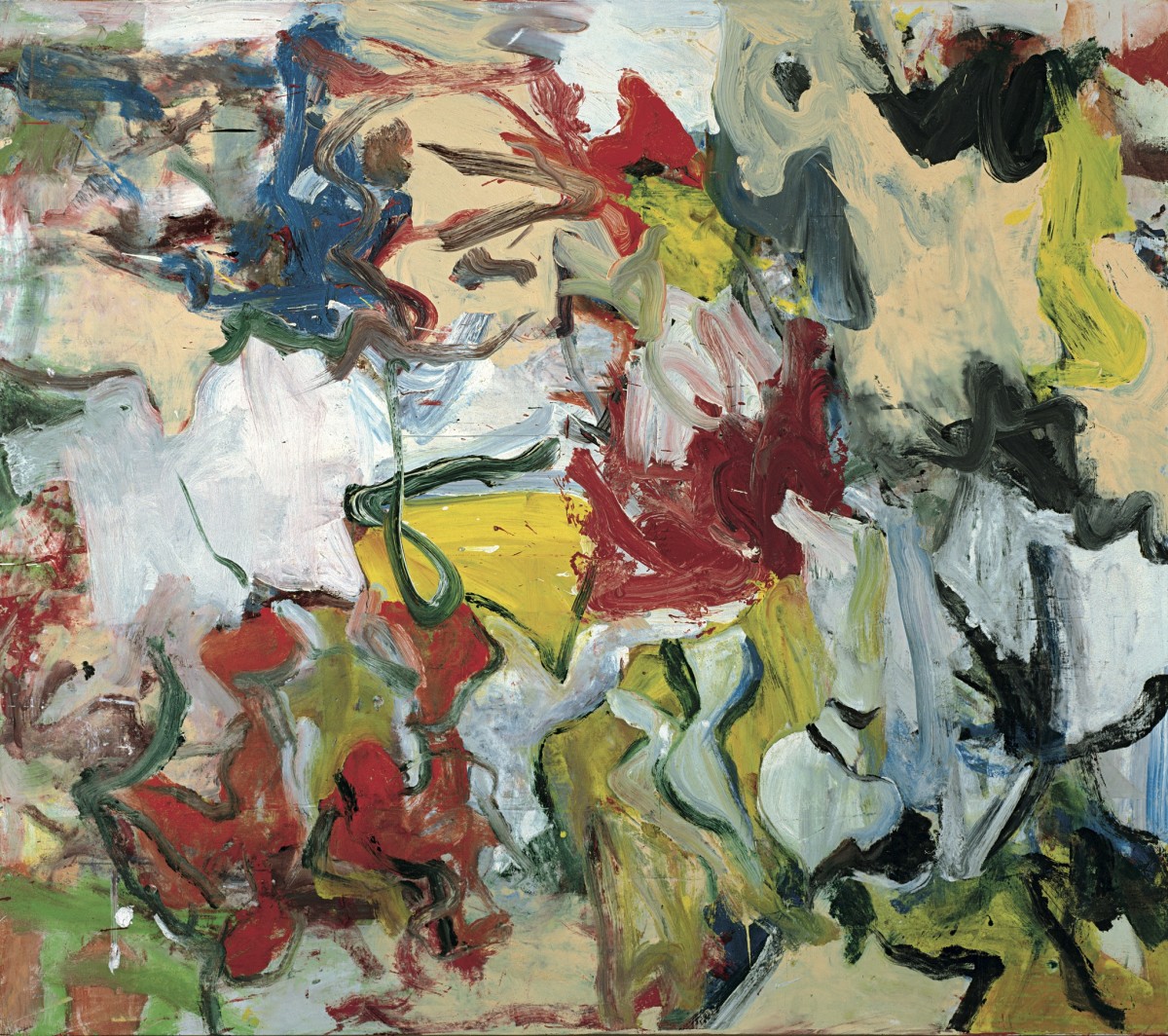
Nobody tells you, when you first stand in front of Untitled XI, that de Kooning was seventy-one years old when he made it. The canvas has the appetite of a much younger man and the economy of a much older one, which is precisely the trick that late style is supposed to pull off and almost never does. A gash of crimson opens at the centre of the picture like something has just been struck there, spreads its arms, and gets no closer to resolving into anything nameable however long you stare. Around it, cream and bone-white ground shoulders its way through gestures of cobalt blue at the upper left, a raw ochre field at bottom centre, and, on the right-hand third of the canvas, a thicket of black strokes that behave less like drawing than like a door slamming somewhere off-stage.
I want to be clear about what I am not going to do here, because the temptation with late de Kooning is enormous and almost always fatal to good criticism: I am not going to tell you this is an old man making peace with mortality, painting his way serenely into the light, the brushwork loosening as the mind loosens, and so on, the whole greeting-card version of decline that curators love because it lets them avoid the harder question of whether the work is simply, on its own unsentimental terms, extraordinary. It is extraordinary. It is also, if you look at it without the violins playing, one of the most aggressive pictures de Kooning ever painted, for all its "lyrical" reputation.
What strikes me first, and what keeps striking me on every return visit, is the speed. Not speed as in "quickly done", though it may well have been; speed as in the picture's internal velocity, the sense that every stroke is still travelling, that the paint has not yet decided where it wants to land. De Kooning worked wet-into-wet, laying paint over paint before anything had a chance to skin over, and here you can feel that decision in your own body: your eye moves the way the brush moved, sliding rather than settling, and the effect is closer to watching weather than to reading a composition.
Every stroke is still travelling. The paint has not yet decided where it wants to land, and neither, thank God, has the old man who put it there.
— Philibert Octavian de GramontThe Paint Surface Has a Memory
There are no characters in Untitled XI in any sense a novelist would recognise, and yet the picture is crawling with them. That crimson mass at centre reads, if you let your eye relax the way de Kooning clearly wanted it to, as a torso, or a wound, or a woman bending, or none of these and all of them in quick, unstable succession. This is not accident and it is not my imagination running wild for the sake of a good paragraph: de Kooning had spent the previous quarter-century building and dismantling the female figure, most notoriously in the snarling, tooth-baring Women of the early 1950s, and by 1975 that anatomy was so deeply wired into his hand that it kept resurfacing even when he had, by every public statement, moved on. He once said he could not sit down to breakfast without the shape of a woman appearing somewhere on the tablecloth. Believe him. It is here, in the loop of that red mass, in the way it swells and narrows like a hip giving way to a waist.
The "objects" of this painting, in the absence of a still life, are the studio's own tools, and de Kooning left their fingerprints all over the surface. He worked with sable brushes so loaded with paint that they left ridges you can trace across the canvas like tyre tracks; he dragged a palette knife through wet passages to open channels down to the ground beneath, which is why certain strokes look scraped rather than laid. Most tellingly, he pressed sheets of newspaper onto sections of the still-wet surface overnight, a studio habit that kept the oil workable for days and occasionally left ghost impressions of print and photograph lifted straight into the paint film, later scraped and painted over but never entirely erased. You are not meant to find these traces consciously. You are meant to feel, without knowing why, that the surface has a memory, that something has been printed and half-erased beneath what you are looking at, which is as good a description of the human unconscious as any I have read in a philosophy seminar.
Anatomy in Retreat, Never in Full Retreat
Critics who insist de Kooning had "left the figure behind" by 1975 are describing his subject matter, not his hand. The hand never left. What changed is that the figure now arrives and dissolves within a single gesture rather than across a whole canvas, so that a torso and a dune, a thigh and a breaking wave, occupy the same few inches of paint and refuse to be pulled apart.
The Knife, the Rag, and the Long Goodbye to Composition
By 1975 de Kooning had spent nearly a decade away from the easel in any sustained sense, absorbed instead in sculpture, and I do not think it is fanciful to say that the sculptor's hand comes back into the paintings with him. There is a new physicality to the mark-making here, a willingness to build up ridges of paint that catch actual light rather than merely depict it, the way a modelled surface in clay catches light. Compare this to the tighter, more architectural compositions of the Women pictures, all those insistent verticals holding a figure in place against a grid, and you can see exactly what has been abandoned: the grid itself. Untitled XI has no scaffolding. It is all-over in the sense Pollock gave that word, except where Pollock dissolved the body entirely into rhythm, de Kooning keeps hauling it back, half-formed, into view.
The palette does an enormous amount of the picture's emotional labour. Cream and bone-white are not neutral here; they are aerated, worked wet against wet with the crimson so that at the edges the red bleeds into pink and the white takes on a faint bruised warmth, as though the whole ground has been standing too close to the wound at the centre. The cobalt gust at upper left arrives like weather from another direction entirely, cool where everything else runs hot, and it is the only passage in the picture that lets your eye rest before the black thicket on the right pulls it taut again. Nothing in this painting is decorative. Every colour is doing structural work, holding the composition's centre of gravity exactly where de Kooning wants it and not one inch further.
What I find most radical, and what the "joyful old man returns to nature" reading conveniently ignores, is how unresolved the painting insists on remaining. De Kooning had the technical command by 1975 to finish anything he wanted finished. He chose not to. The canvas stops rather than concludes, several passages left at a pitch of wetness and incompletion that a lesser or more anxious painter would have felt obliged to tidy. That refusal to tidy is, I would argue, the single most youthful thing about a picture made by a man past seventy.
He had the command to finish anything he wanted finished. He chose, again and again, to stop instead of to conclude.
— Philibert Octavian de GramontRotterdam to the Springs: A Return Disguised as a Departure
Willem de Kooning trained the old, hard way, eight years at Rotterdam's Academy of Fine Arts and Techniques, an education soaked in draughtsmanship and craft guild discipline that never left him, however wild the later paint got. He stowed away for New York in 1926 and spent the next quarter-century becoming, alongside Jackson Pollock, the figure most people mean when they say Abstract Expressionism, though de Kooning himself resisted the label his whole life, insisting that his fights were with the figure, not against it. The Women series of the early 1950s, snarling and toothy and controversial enough to divide the New York art world down the middle, made him famous and nearly typecast him. He spent the following two decades restlessly avoiding to repeat himself: urban abstractions, the sun-blasted Parc Rosenberg landscapes, a move out to the Springs on Long Island in 1963 that put ocean light permanently into his eye.
Then, from the late 1960s into the early 1970s, painting largely stopped. De Kooning turned to sculpture instead, working in clay with his eyes closed at points, translating gesture directly into three dimensions with the help of a foundry, and the experience seems to have retaught his hand something it had half-forgotten: how paint, like clay, is a substance that can be pushed, dragged, torn and folded, not merely applied. When he returned to canvas in earnest in 1975, at seventy-one, he did not ease back in. He produced twenty large paintings in roughly six months, a sculptor's stamina applied to a painter's problem, and Untitled XI comes directly out of that burst, first exhibited that October at Fourcade, Droll in New York before travelling to Seattle.
The year matters for reasons beyond biography. By 1975 the New York art world that had made de Kooning's reputation was already being declared over by its own critics, Minimalism and then Conceptual Art having spent a decade insisting that gesture, emotion and the painterly hand were finished business, embarrassing relics of an earlier and more naive faith in the artist's touch. De Kooning's response was not an argument. It was twenty canvases that simply behaved as though none of that had happened, painted with a confidence bordering on contempt for fashion, which is the only sensible response an artist of his stature could have given.
An Old Argument, Refought in Colour
The 1970s American art world had largely declared the expressive gesture obsolete. De Kooning's 1975 canvases, painted at the peak of that consensus, are best understood as a rebuttal delivered not in essays but in six months of uninterrupted, unfashionable, magnificent painting.
The Central Crimson is Not a Sunset
My reading, and I offer it as argument rather than doctrine, is that Untitled XI stages a collision between two subjects de Kooning had spent his whole career unable to separate: the female body and the Long Island landscape. Both had by 1975 become so thoroughly internalised that neither could appear on his canvas without dragging the other in behind it. The crimson mass at centre carries the anatomical charge of the old Women, hips, breast, an opened mouth, but it sits inside a field of cream and blue-grey light that behaves exactly like the dune-and-ocean atmosphere he painted throughout the 1960s. Read it as a body and the landscape keeps intruding. Read it as a landscape and the body keeps insisting. That refusal to settle is not a failure of the picture; it is the picture's entire argument.
There is a reading, popular among curators keen to soften de Kooning's reputation for misogyny in the earlier Women pictures, that the 1975 series represents a kind of erotic reconciliation, the body no longer fought with but folded gently into nature, violence replaced by lyricism. I find this only half-true and, frankly, a little too convenient. The crimson at the centre of Untitled XI does not read to me as reconciled. It reads as a wound that has simply learned better camouflage, dressed now in a palette pretty enough to be mistaken for a sunset over the dunes rather than a body under duress. The old aggression of the Women is still here. It has just been given a more forgiving light to stand in.
What this painting means to me, standing in front of it, is that de Kooning never believed abstraction was an escape from the body, only a way of making the body's pressure legible without the burden of a face. That refusal to choose between figuration and abstraction, between violence and beauty, between a woman and a dune, is the single idea his entire late career circles obsessively, and Untitled XI is one of its clearest statements: a picture that insists meaning can travel through paint without ever consenting to arrive.
The crimson has simply learned better camouflage, dressed now in a palette pretty enough to be mistaken for a sunset rather than a body under duress.
— Philibert Octavian de GramontThe Pleasure of Brushwork that Anger Can't Produce
I have just spent several hundred words insisting that the body in this painting is still under duress, and honesty obliges me to hand you the opposing case, because it is a strong one and de Kooning himself, late in life, gave interviews that support it far more than they support mine. He spoke often in the 1970s of the freedom sculpture had given him, of no longer feeling obliged to resolve a canvas into a legible figure, of wanting simply to record the light off the water near his studio. Seen through that lens, Untitled XI is not a wound at all. It is weather: the specific, remembered light of a Long Island morning, translated directly into paint by a hand too skilled and too free by 1975 to bother distinguishing between a wave and a woman, because at seventy-one, with the whole architecture of figuration mastered and set aside, why would he still be counting the difference.
What makes this reading persuasive, rather than merely charitable, is the sheer physical pleasure evident in the brushwork, a pleasure that anger does not usually produce. There is a looseness in the wrist here, a willingness to let a stroke run out of paint mid-gesture and simply stop, that reads less like combat and more like someone enjoying, without apology, the late reward of a lifetime's technical mastery. Perhaps both readings are true at once, the body's old pressure and the landscape's new freedom occupying the same red passage without cancelling each other out. I am not in the business of resolving that tension for you. I think de Kooning would have been insulted if I tried.
One last comparative pressure: hang this picture, in the mind if not on the wall, beside a classic 1950s de Kooning Woman and notice what has been lost and what has been gained. Lost is the prosecutorial face, the teeth, the cartoon aggression that made those earlier works impossible to ignore and easy to reduce to scandal. Gained is a broader weather system in which the old violence can still appear without monopolising the entire meaning of the canvas. Untitled XI is not kinder so much as larger. It can hold the wound and the dune, the memory of combat and the late freedom of the hand, without forcing the viewer to pick a single slogan-sized interpretation before the paint has finished speaking.
That largeness is why I keep returning to Chicago for this picture rather than treating it as a footnote to the Women or as a warm-up for the 1980s ribbons. It is a complete late statement made while de Kooning still had the physical means to contradict himself on purpose. Contradiction, in his case, was never a defect of mind. It was a method for keeping paint honest about how desire, landscape, and memory actually coexist: messily, beautifully, and without a final vote.
There is also a practical studio fact that soft readings of late de Kooning tend to forget: large oil paintings made at speed are physical work. Arms tire. Decisions accumulate as weight. The scraped and reopened passages in Untitled XI are not only aesthetic choices; they are the fossil record of a day, and then another day, of a man in his seventies still willing to destroy a beautiful passage because it had become too settled. That willingness is the opposite of complacent late style. Complacency preserves what already looks good. De Kooning's late method, at least in 1975, still preferred risk to preservation.
Compare, if you can, the temper of this canvas with the thinner, more ribbon-like white paintings that would occupy him in the 1980s. Those later works have their own severe beauty, and they have attracted a large literature about illness, assistance, and authorship that is not my subject here. What matters for Untitled XI is that 1975 still sits on the far side of that thinning. The paint is fat. The contrasts are high. The central red has the density of a decision that has been fought for rather than exhaled. If you want the last moment when de Kooning's full physical vocabulary and his full freedom from early figurative obligation coexist at maximum pressure, this campaign of pictures is among the strongest places to look, and this canvas is among the strongest of the campaign.
The six-month campaign of 1975 that produced Untitled XI and its companions is easy to romanticise after the fact: the old master returns from sculpture, the studio fills with large canvases, the October New York exhibition reasserts a career. What is harder, and more interesting, is to recover how unfashionable the enterprise was at the time. American painting in the mid-1970s was deep into post-painterly cool, conceptual severity, and a widespread suspicion that the loaded brush had exhausted its claims. De Kooning answered not with a theory but with output. Twenty large paintings in half a year is not a mood. It is a labour schedule, and the labour shows in the scraped passages, the wet-into-wet collisions, the places where a knife has dragged colour across colour until earlier decisions become geology rather than surface.
Sculpture, which occupied him so heavily in the years just before, is not a biographical side note here. Working clay and bronze re-taught his hands a kind of mass and resistance that pure easel painting can forget. When he returned to linen, the strokes often behave like matter pushed through space rather than colour laid on a flat design. You can see it in the way the central crimson of Untitled XI seems to occupy volume, not merely area, and in the way surrounding creams and blue-greys open around it like air around a body. Critics who treat the 1975 pictures as "landscape abstractions" are not wrong about the East Hampton light, but they understate how much of the body's three-dimensional pressure survived the trip back from the sculpture studio.
I am equally unwilling to let the late-style myth of serenity do all the interpretive work. Yes, de Kooning spoke of freedom, of water light, of no longer needing to resolve every canvas into a legible woman. Those statements are part of the historical record and they matter. But the crimson mass at the centre of this particular picture does not behave like pure weather. It concentrates. It insists. It holds the kind of anatomical charge his earlier Women made infamous, even when no face is present to prosecute the charge. The useful critical move is not to choose between "body" and "landscape" as if one cancelled the other. The useful move is to notice that de Kooning had spent decades proving those two subjects were, for him, the same pressure under different names.
Institutionally, the Art Institute of Chicago's stewardship of the canvas places it among the strongest late Abstract Expressionist holdings in the American Midwest, where it can be seen against both the museum's broader modern collection and the longer American argument about whether gesture still means anything after Pop, Minimalism, and conceptual art had tried to retire it. Standing in Gallery 297, you are not looking at a relic of 1950s New York. You are looking at a 1975 rebuttal, painted when many serious people thought the rebuttal unnecessary. That historical belatedness is part of the picture's nerve. De Kooning was not catching a wave. He was painting against a consensus that preferred him already archived.
Formally, the picture also rewards a slower second look at edges. Where a younger de Kooning often locked figure and ground into combat along hard contours, Untitled XI lets boundaries fray, reopen, and reassign roles. A cream passage that reads as ground on first glance becomes a stroke with its own agency on the second; a blue-grey that seemed like sky starts to behave like a plane of flesh under cold light. This is not indecision. It is a late technique for keeping the eye from settling into a single, flattering story about what it is seeing. If the painting feels inexhaustible, that is why: every stable reading is engineered to become slightly wrong after another minute of looking.
Finally, I want the ethical temperature of the Women debate to remain audible without letting it flatten the canvas into a courtroom exhibit. The earlier figurative works still divide viewers, and they should. The 1975 series does not erase that history by becoming prettier. What it does offer is evidence that de Kooning's lifelong subject was never only "woman as motif" and never only "paint as paint," but the harder problem of how desire, aggression, weather, and memory can occupy one surface without a hierarchy that would make any of them merely symbolic. Untitled XI is one of the clearest surviving statements of that problem. It does not solve it. It keeps it dangerous, which is a higher compliment than resolution.
Between Gorky's Ghost and Monet's Late Water
De Kooning stands between Arshile Gorky's biomorphic surrealism, which first taught him that a curved line could carry a body's whole erotic charge, and the late Monet of the Nymphéas, whose failing eyesight dissolved the pond at Giverny into pure atmosphere. Untitled XI borrows Gorky's anatomical undertow and Monet's refusal to let form settle, then adds something neither of them had: the blunt, knife-dragged physicality of a man who had just spent years working clay with his hands.
An Old Man's Fistfight with the Light. And He is Winning
I do not know a more instructive lesson in what late style can actually mean, as opposed to what obituaries like to claim it means, than standing in front of Untitled XI. This is not decline dressed up as wisdom. It is a seventy-one-year-old painter, freshly returned from years and bronze, throwing the full weight of a lifetime's technical command at a canvas and avoiding, at every possible turn, to let that command calcify into mere competence. The picture stays dangerous. It stays unresolved. It denies the comfortable narrative that old age softens an artist's nerve, and in such sense, it becomes one of the great, underappreciated arguments for why an artist's seventies can be as ferocious as his thirties.
What I will not do is pretend the painting settles its own argument, because it does not, and any critic who tells you it does is selling you a tidier picture than the one on the wall. The body is here and the landscape is here, the wound is here and the sunset is here, and de Kooning, characteristically, refuses to adjudicate between them. That refusal is the achievement. Go and stand in front of it in Chicago, in Gallery 297, and let your eye do what mine keeps doing: chase the red, lose it in the cream, find it again in the blue, and never quite arrive anywhere you can put a full stop.