The Merry Family
A riot of song, wine and pipe smoke, where the old set the tune and the young learn every bad note by heart
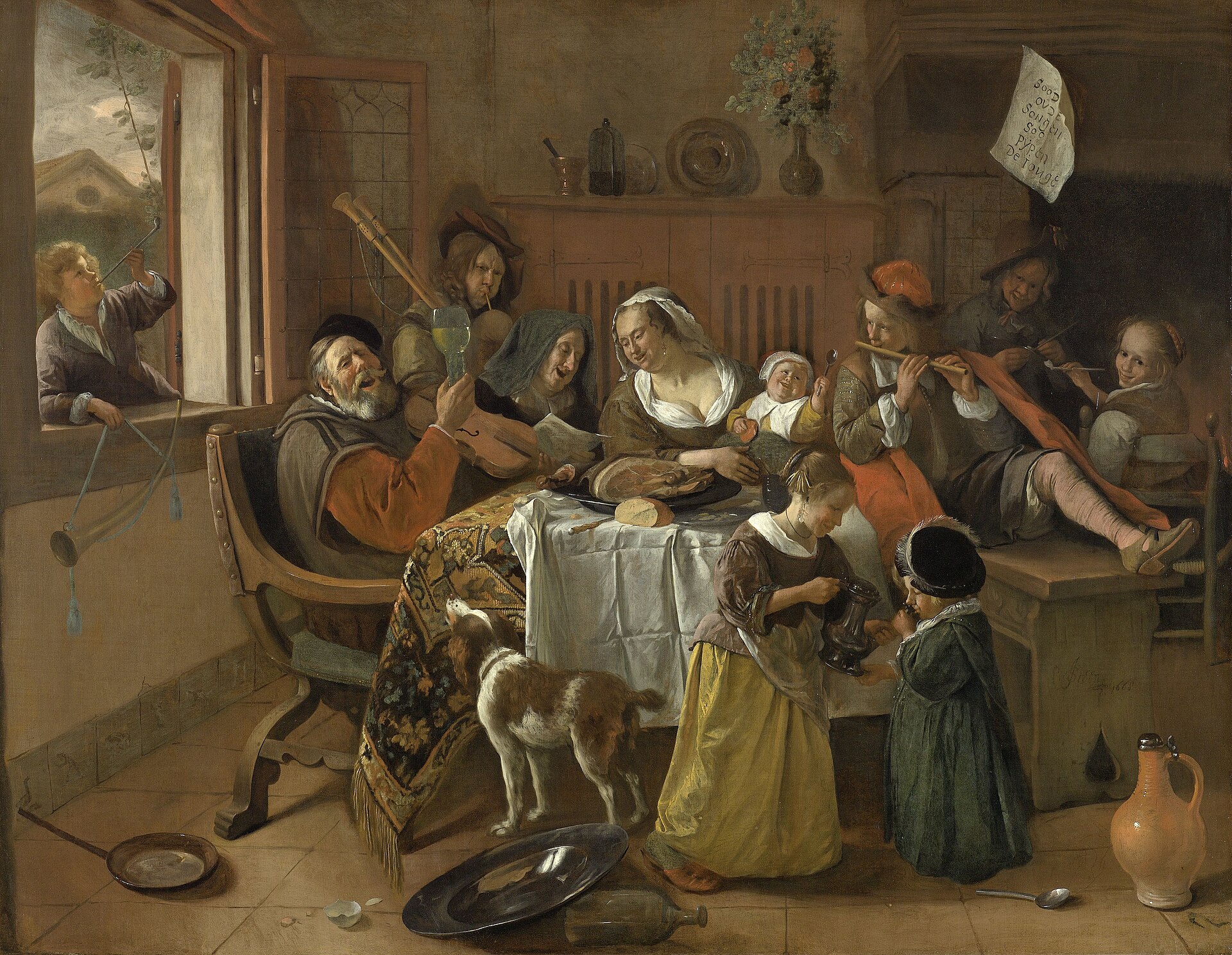
A Cluttered Parlour Where Decorum Has Left the Building
Step into Jan Steen’s The Merry Family and you don’t enter a painting; you barge straight into a living room that has surrendered to pure, unfiltered revelry. The space is no pristine Dutch interior; it is a glorious battlefield of overturned chairs, half-eaten hams, scattered pipes and wine jugs that look ready to topple. Light pours in from the left, catching the shine on a glass, the flush on a cheek, the gleam of a violin. There is no grand architectural backdrop, no distant landscape, just the warm, smoke-filled intimacy of a prosperous middle-class home that has decided, for one glorious evening, that moderation is for suckers.
The composition is a deliberate riot: figures overlap, gestures fly in every direction, and your eye ricochets from the singing father on the left to the piping children on the right. The mantelpiece note hangs like a quiet accusation: “As the old sing, so shall the young pipe”, but nobody is listening. The room itself is the real subject: prosperous, cluttered, alive. Steen has turned domestic disorder into high theatre, proving that the most interesting art often happens where the furniture gets pushed aside.
The lighting is warm and forgiving, the sort that flatters flushed faces and spilled wine alike. No dramatic shadows here; this is not Caravaggio’s theatre of sin. Steen bathes everything in a golden, tavern glow that makes excess look almost wholesome, until you notice the toddler clutching a spoon like a drunkard’s sceptre.
The room itself is the real subject: prosperous, cluttered, alive. Steen has turned domestic disorder into high theatre.
— Philibert Octavian de GramontThe Cast of a Family Farce
At centre stage is the father: glass raised, violin tucked under one arm, mouth wide open in full-throated song. He is the ringleader, the man who clearly believes that a little wine improves the harmony. Beside him the mother cradles a plump toddler on her lap; her dress is cut low, her expression one of tipsy delight. The grandmother belts out the chorus with the gusto of someone who has seen it all before and is damned if she will miss a note. The children? They are the star pupils: one pours wine straight from the jug, another puffs on a long clay pipe, a third toots a flute with the earnestness of a miniature adult. Even the dog at the table looks hopeful for scraps, tail wagging in solidarity with the general gluttony.
The objects are not decoration; they are evidence. The long pipes speak of exotic new vices imported with the spice trade; the wine (not mere beer) signals wealth; the ham and bread speak of plenty that is being cheerfully squandered. And that note on the mantelpiece? It is the punchline delivered deadpan. Steen has filled the canvas with enough detail to keep you laughing for hours, yet every jug, every pipe, every flushed cheek is a quiet accusation.
The boy at the window, smoking and blowing a horn, is the perfect Steen touch: the next generation already practising its vices in full view of the street. The family is not monstrous; it is ordinary. That is what makes it sting.
Cheeky Grins and Moral Hangovers
Steen does not paint villains. He paints people who are having far too much fun to notice they are setting the worst possible example. Their expressions are not wicked; they are merry, affectionate, utterly human. The genius lies in making you like them before you remember you are supposed to disapprove.
Loose Brush, Tight Wit is Steen’s Recipe for Lively Turpitude
Steen’s style is the visual equivalent of a good tavern brawl: energetic, colourful, impossible to ignore. The brushwork is loose enough to suggest movement (look at the way the violin bow seems to blur mid-stroke), yet precise enough to catch the sheen on a wine glass or the embroidery on a sleeve. He piles on detail without ever feeling fussy: every fold of fabric, every crumb on the table, every wisp of pipe smoke adds to the sense that you could reach in and join the party.
The palette is pure Dutch abundance: warm ochres and crimsons for the clothes, glowing yellows for the light, deep greens and browns for the clutter. Colour does not decorate; it animates. The reds of flushed cheeks and spilled wine bleed into one another until you cannot tell where celebration ends and consequence begins. This is not the cool restraint of Vermeer; it is the noisy vitality of a man who knew exactly how a room looks when the adults have had one glass too many.
Compositionally it is a masterclass in controlled disorder. Diagonals pull your eye across the canvas, overlapping figures create depth without perspective tricks, and the whole thing feels like it could tip over at any moment, just like the family itself.
Every flushed cheek and spilled drop is both celebration and quiet accusation.
— Philibert Octavian de GramontThe Tavern Keeper Who Painted His Own Life. Mockery Included
Jan Havicksz. Steen (c. 1626–1679) was no starving artist. Born into a brewing family in Leiden, he ran taverns himself, married into money, buried wives, raised children and still found time to paint hundreds of scenes that look suspiciously like his own front room. “A Jan Steen household” became a Dutch expression for glorious disorder, a compliment wrapped in gentle mockery. He knew exactly what he was painting because he lived it.
The year is 1668. The Dutch Republic is at the peak of its Golden Age: trade wealth pouring in, ships returning from the East Indies, Calvinist preachers thundering against luxury while the middle classes quietly enjoyed it. Genre painting was the perfect vehicle: affordable, relatable, and able to smuggle moral lessons inside a good laugh. Steen took the tradition of Pieter Bruegel the Elder’s moralising peasant scenes and turned the volume up to eleven. He gave the Dutch burghers a mirror they could laugh at, and perhaps wince at, without ever feeling preached at.
Prosperity’s Dangerous Party
After decades of war with Spain, the Dutch were rich, confident and nervously aware that wealth could corrupt. Steen’s painting captures the tension perfectly: abundance on the table, temptation in every glass, and a proverb on the wall reminding everyone that the children are watching.
A Proverb That Bites While You’re Still Laughing
My reading is brutally simple and cheerfully uncharitable: this is not a warning against vice; it is a celebration of it, dressed up in the respectable clothes of moral instruction so the burghers could hang it in their parlours without blushing. Steen is winking at us the entire time. The parents are not monsters; they are us on a Saturday night. The children are not victims; they are fast learners. The dog is the only honest creature in the room; it just wants food and doesn’t pretend otherwise.
The symbolism is everywhere and nowhere. The pipes represent the new colonial vice of tobacco; the wine stands for imported luxury; the note on the mantelpiece is the moral fig-leaf that lets the painting into polite society. The clutter itself is the real symbol: moral disorder masquerading as domestic bliss. Yet Steen never lets the finger-wagging win. The sheer joy radiating from every face makes you suspect he secretly approves of the whole glorious mess.
To me, this painting means that life is too short and too messy for perfect examples. It relates directly to Bruegel’s great moral panoramas but strips away the cosmic scale and brings the sermon home to the kitchen table. It also looks forward to the great 19th-century realists who would paint working-class life with equal affection. Steen is the court jester of Dutch painting: he mocks us, loves us, and refuses to let us take ourselves too seriously.
The children are not victims; they are fast learners. The dog is the only honest creature in the room.
— Philibert Octavian de GramontCalvinist Restraint and Humour
What makes The Merry Family unique is its refusal to be either pure satire or pure celebration. Most moralising genre scenes of the period feel like lectures with pictures. Steen gives us a party with a punchline. He paints the fun so convincingly that you almost forget the warning, until the proverb note catches your eye and you realise you’ve been had. That double vision is his signature genius.
A different perspective sees the painting not as a cautionary tale but as a love letter to human imperfection. In an age obsessed with Calvinist restraint, Steen dares to suggest that a little excess might be the very thing that makes life worth living. He humanises vice so thoroughly that the moral feels almost affectionate. Unlike the austere history painters who gave the Dutch Republic its heroic self-image, Steen gave it its sense of humour (and its honesty).
Beyond Bruegel and Vermeer
Steen stands between Bruegel’s cosmic moral panoramas and Vermeer’s quiet domestic poetry. He takes Bruegel’s moral bite and Vermeer’s intimate observation and mixes them with tavern humour. The result is something entirely his own: art that feels like gossip, looks like life, and leaves you laughing at yourself.
The Party That Never Quite Ends Until the Bill Arrives
To stand before Jan Steen’s The Merry Family is to feel the warm tug of recognition mixed with the cold stab of self-knowledge. In this uproarious canvas the great Dutch jester does what only the finest painters can do: he shows us our own folly so vividly and so affectionately that we laugh first and wince later.
In the end the painting’s power lies in its refusal to choose sides. It celebrates the party and warns against the hangover in the same breath. Steen invites us in, pours us a glass, and leaves us to decide whether we are laughing at the family, or at ourselves.