The Liver is the Cock's Comb
A dying language of the body, a man who had buried one country and was quietly rehearsing the loss of another
Sensations of a Body, a Farm, and a Memory. All Piercing the Mind
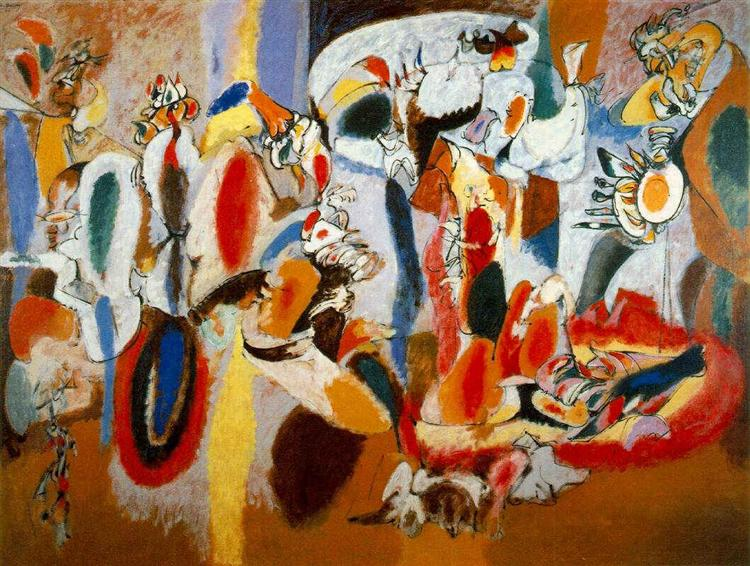
Forget, for a moment, everything you have been told about Abstract Expressionism arriving fully formed like a thunderclap over lower Manhattan in 1947. Three years earlier, in a canvas nearly two and a half metres wide, an Armenian refugee working under a name he had invented for himself had already done the hard part. The Liver is the Cock's Comb is not a battlefield of paint, not yet; there is no heroic gesture here, no signature drip claiming territory. It is something stranger and, to my eye, considerably more moving: a field remembered so hard that the memory has started to grow its own anatomy.
The ground is a burnt ochre, the colour of a Virginia hayfield gone dry in August, or perhaps of Armenian earth Gorky had not seen in over two decades. Across it float forms that refuse to hold still under any single name. A white shape at the upper right curls like a bird's throat and also, if you let your eye slacken, like a cock's comb rising off a head that is not quite there. Lower down, deep crimson lobes hang and drip in a way that recalls nothing so much as a butcher's window, or a body's most private machinery laid open to the light. A vertical seam of indigo blue cuts through the composition like a spine, or a curtain half drawn on a room you were not meant to enter.
Nothing here obeys perspective. Nothing sits still long enough to be labelled. And that, I would argue, is the entire point: Gorky is not painting a farm, or a body, or a memory of Armenia. He is painting the sensation of all three arriving in the mind at once, unfiled, ungoverned, refusing the tidy administration that language and geometry usually impose on experience.
He is not painting a farm, or a body, or a memory of Armenia. He is painting the sensation of all three arriving at once, unfiled and ungoverned.
— Philibert Octavian de GramontA Nameless Cast, Only Organs
There are no people in The Liver is the Cock's Comb, and yet the painting is crowded with presences, each one behaving as though it has a will of its own. Call them actors without a script. At the upper left, a hooked ochre form leans in like a figure bent over a table, its edge sharpened almost to a beak; scholars have long noted the picture's kinship with a rooster's head, and I will not pretend I do not see it too, jaunty and slightly absurd, a fool's cap masquerading as an animal. Beside it, ribbons of white and rose twist downward, part drapery, part wing, part something closer to viscera, refusing at every turn to resolve into a single decent object.
The title's two nouns, liver and cock's comb, are themselves the great supporting cast, because they will not sit still in the mind. The liver was, in the ancient world, a symbol of the soul and passion; a coxcomb is at once a rooster's crest, a flowering plant, a jester's cap and a fool. Set the two side by side and you get an equation that refuses to balance: the body's most solemn organ married to its silliest headgear, love yoked to folly, prophecy yoked to farce.
Lower in the canvas, deep red forms pool and hang with unmistakable anatomical weight, echoes of viscera, of pomegranates split open, of something that has been butchered or born. Every shape in this painting does at least two jobs: one botanical, one bodily, sometimes a third that is frankly erotic. Nothing here is decoration. Everything is evidence of a mind refusing to choose between the garden and the grave.
Forms Withholding to Confess
Gorky's genius here is withholding. He gives you just enough resemblance, a beak, a womb, a comb, a stalk, to make identification irresistible, then dissolves it before you can pin the picture down. The forms are not puzzles waiting to be solved. They are memories behaving the way memories actually behave: half-recovered, over-lit in places, gone dark in others, and entirely uninterested in your need for a caption.
Painting Like the Wound is Still Fresh
Technically, this painting is a hinge, and I mean that in the most literal sense: it swings the door between two rooms of twentieth-century art and leaves it standing open for everyone who came after. The drawing is Gorky's own peculiar synthesis of Picasso's Cubist scaffolding and Miró's biomorphic play, filtered through a line so confident it barely touches the canvas before curling away again, a calligrapher's hand let loose on a butcher's subject. But it is the paint handling that marks the real departure. Gorky thinned his oils with turpentine until the pigment behaved almost like watercolour, pooling, staining and bleeding into the canvas rather than sitting obediently on top of it.
The effect is a surface that looks, in places, as though it were still wet, still deciding what it wants to become. Look closely at the crimson lobes near the centre and you can see the paint has been allowed to run downward under its own weight, gravity doing part of the composing. This is not accident dressed up as intention; it is intention smart enough to let accident in as a collaborator. Paint as a fluid event would become central to Abstract Expressionism, but here it retains a lyrical precision that is distinctly Gorky's.
Colour, meanwhile, does the emotional heavy lifting that drawing alone could never manage. The dominant ochre is not merely a Virginia field in August; it is the colour of dried blood gone brown, of old photographs, of a landscape remembered rather than observed. Against it, the crimsons read as raw and immediate, the indigo band as a single cool intake of breath in an otherwise feverish room. Gorky had studied Kandinsky closely enough to know that colour could carry argument on its own, without drawing's help, and here he lets it.
The paint has been allowed to run downward under its own weight, gravity doing part of the composing.
— Philibert Octavian de GramontA Man Who Reinvented Himself
Vosdanig Manoug Adoian was born around 1904 in the Armenian village of Khorkom, near Lake Van, in territory then held by the Ottoman Empire. In 1915 that world was destroyed. The Armenian Genocide scattered and murdered his community; by 1919 his mother, Shushan, had died of starvation in Yerevan, a loss Gorky carried for the rest of his life and returned to in paintings such as The Artist and His Mother. He arrived in the United States in 1920 as a teenager and rebuilt his identity from the ground up under the name Arshile Gorky.
Through the 1920s and 1930s he taught himself painting by devout, almost monastic imitation, working through Cézanne, then Picasso, then Miró, with such intensity that critics dismissed him as derivative. He was not being lazy; he was serving an apprenticeship no art school in Armenia could have given him, teaching himself the entire grammar of European modernism from reproductions and gallery visits, alone, in a rented studio, because history had taken his teachers along with everything else. By the early 1940s that apprenticeship was ending. War in Europe had driven the great Surrealists, Breton, Matta, Max Ernst, into New York exile, and Gorky, uniquely among the younger American painters, was taken seriously by them as an equal rather than a curiosity.
In 1941 he married Agnes Magruder, and her family's farm in Virginia, Crooked Run, became his summer retreat from the city. There, walking fields that resembled nothing so much as the Armenian countryside of his childhood, he filled notebook after notebook with drawings of grass, roots, insects and flowers, material he would carry back to his New York studio and transmute, through the winter of 1943 into 1944, into the great paintings of his maturity. The Liver is the Cock's Comb is the largest and most ambitious of that harvest: not a picture of Virginia, and not a picture of Armenia, but the place where the two landscapes, separated by an ocean and a genocide, were finally allowed to overlap.
A Title Already in Print
The Arshile Gorky Foundation’s chronology records that Gorky finished the painting in April 1944 and that Sidney Janis reproduced it in Abstract and Surrealist Art in America that year. This essay makes no further attribution for the title.
Gorky's Load-Bearing Puns
My reading of this painting starts from the title, because the title is where Gorky, usually so reticent about explaining himself, chose to be almost indecently direct. A liver, an ancient organ of prophecy and passion; a cock's comb, which is at once a rooster's crown, a jester's cap and a slang word for the most obvious male anatomy imaginable. Put the two together and you get a sentence that is both a diagnosis and a joke: the seat of the soul is also the seat of vanity and lust, and no amount of solemnity will keep the two apart for long. I find this refreshingly honest in a way that most mid-century artist statements, dressed up in borrowed philosophy, rarely manage.
Read the forms with that pun in mind and the whole canvas opens up. The crimson lobes at centre are viscera and fruit and genitalia simultaneously, the white crested shape at the upper right is bird, jester's cap and phallus in the same six inches of canvas, and the picture as a whole becomes less a landscape than an anatomy lesson conducted by a man who had watched too many bodies fail, in Van, in Yerevan, in the crossing to America, to paint a body without also painting its vulnerability. There is real grief folded into this canvas, but Gorky refuses to let grief sit alone; he keeps interrupting it with the coxcomb's foolishness, the egg's domestic comedy, the sheer visual pleasure of colour doing exactly what colour wants to do.
I do not read this as a painting about Armenia in any illustrative sense, there are no flags, no massacres, no literal villages here, and I distrust critics who insist on decoding it that way, forcing biography onto abstraction like a police sketch. What I read instead is a mind that has learned, the hard way, that memory does not arrive in neat chapters. It arrives as Virginia grass and Armenian orchard at once, as a mother's death and a child's laughter at once, as an organ of the soul wearing a fool's crown. That refusal to separate grief from vitality, tragedy from farce, is, to my mind, the single most important thing this painting has to say, and it says it without a word of literal narrative.
The seat of the soul is also the seat of vanity and lust, and no amount of solemnity will keep the two apart for long.
— Philibert Octavian de GramontWhat If This Isn't a Surrealist Painting At All?
The standard account, repeated in nearly every survey text, files Gorky under Surrealism's American branch office: Breton's blessing, the biomorphic vocabulary, the dream-logic forms. I want to push back on that filing, gently but firmly. Surrealism, at its European core, was fundamentally a project of the unconscious, dredged up through automatism, chance and free association, and largely indifferent to the specific, lived, documented history of the artist producing it. Gorky's forms, by contrast, are not arbitrary dream-symbols; they are the residue of an actual field he walked, an actual mother he lost, an actual body of drawings made from actual grass and roots at Crooked Run Farm. This is not automatism. This is memory doing very deliberate, very controlled work under the cover of Surrealist permission.
Seen this way, the painting looks less like a European import and more like something closer to elegy, in the oldest sense: a formal lament that uses beauty and even comedy as a container strong enough to hold loss without being crushed by it. That is a very different tradition from Breton's automatic writing, closer in spirit to the way certain Armenian and Near Eastern poetic forms braid grief and celebration into the same breath. Gorky needed Surrealism's vocabulary the way a refugee needs a second language: not because it expressed his native feeling perfectly, but because it was the language available, spoken by the people in the room who would actually look at what he made.
A further heresy, while I am at it: I do not think this painting is primarily "about" abstraction versus figuration at all, the axis on which most art-historical accounts of it turn. I think it is about translation, the impossible, necessary work of carrying one destroyed world inside another, borrowed one, and finding forms flexible enough to hold both without either collapsing into mere illustration. Judged on those terms, The Liver is the Cock's Comb is not a way-station on the road to Jackson Pollock. It is its own destination, and arguably the more sophisticated achievement.
Between Miró's Playground and Pollock's Storm
Gorky stands at the hinge between Miró's whimsical biomorphism and the raw physical urgency Pollock would unleash within a handful of years. He borrows Miró's love of floating, punning forms but refuses Miró's lightness; he anticipates Pollock's belief in paint as living event but keeps drawing, never abandons the line, in a way Pollock ultimately would. The result sits, deliberately or not, exactly between two revolutions, indebted to neither.
Do Not Turn It into a Premonition
It is tempting to turn every mature Gorky painting into evidence from a later tragedy. Resist that temptation. The Liver Is the Cock's Comb is wounded, certainly, but it is not a coded prediction; it is a present tense of looking, feeling and inventing, a canvas alive to growth as much as to damage.
I refuse to let biography flatten the painting into pure tragedy, because the canvas itself refuses that flattening. There is too much wit here, too much sheer pleasure in the way colour pools and runs, too much of the coxcomb's foolery mixed in with the liver's solemnity, for it to become a note of despair. It is, instead, a working demonstration of how a person carrying catastrophic loss can still make something that laughs at itself and insists on vitality as an act of stubbornness rather than denial.
That is why the canvas refuses the clean categories that critics adore because they make a museum label feel briskly competent. It is neither a coded autobiography nor a private dream emptied of history; neither a landscape carried intact from Virginia nor a relic transported intact from Armenia. Its achievement is more difficult. Gorky lets remembered places, bodily metaphors and painterly decisions interfere with one another until each becomes less certain and more alive. The eye keeps proposing a name, then has to withdraw it. A form becomes a flower, then an organ, then a bird, then merely a run of paint, and the loss of certainty is not a failure of description. It is the emotional event the picture stages. Gorky makes looking feel like recollection: intimate, unreliable, stubbornly physical and never finished. This is also why the scale matters. A small image can be tidied into an illustration on a screen; at Buffalo the painting makes the viewer travel. The blue, red and ochre passages do not resolve into a command from a safe distance. They make a field in which the viewer has to negotiate. That negotiation is Gorky's generosity. He does not demand a single meaning, yet he will not permit indifference. The painting keeps the body alert, the mind mobile, and every quick conclusion slightly embarrassed. It leaves no false comfort, only attention and return.
That, finally, is what I want readers to take from this canvas: not another entry in the tidy relay race from Cubism to Surrealism to Abstract Expressionism, but proof that the most necessary art is made by people translating unbearable private history into a form other people can actually stand in front of and feel something. Gorky did that here, at enormous cost to himself, with more tenderness and more mischief than he is usually given credit for. Go and stand in front of it in Buffalo. Let it refuse to explain itself. That refusal is the whole gift.