The Colour of Jealousy
A canvas built for three, in which one man's face has already turned the colour of poison
Painting a Diagnosis
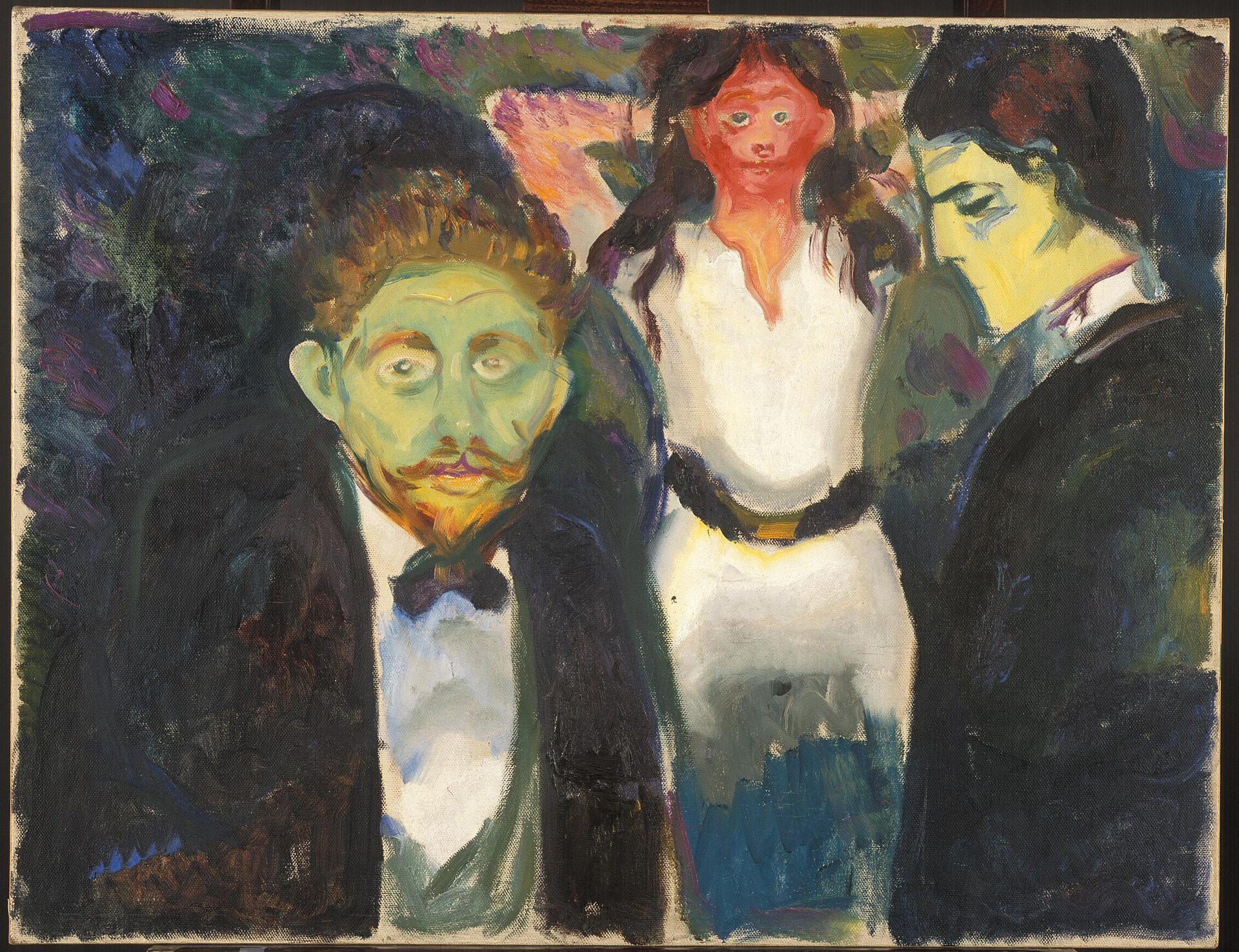
There is a particular kind of painting that does not want your admiration; it wants your confession. Edvard Munch's Jealousy of 1907 is one of them. Three figures are crushed into a shallow, sourceless space, no floor to stand on, no ceiling to shelter under, just a churning wall of green and violet paint that could be a garden, a night sky, or the inside of somebody's skull. In the foreground, cropped at the chest like a hostage photograph, a man's face has been painted the exact sickly green of something gone off in the larder. His eyes do not blink. They are aimed straight at us, the viewers, as though we are the ones who did this to him.
Munch does not paint jealousy the way an illustrator would, with a raised eyebrow and a folded pair of arms. He paints it as a physiological event: a face literally discoloured by an emotion, the way a bruise discolours skin. That green-gold head, jammed awkwardly against the black wedge of a formal jacket and a limp bow tie, belongs to a man who has clearly not slept, and who has been made to sit for his own portrait at the precise moment his private catastrophe became visible to strangers. Behind him, oblivious or indifferent, a woman in white stands with her hands clasped low at a gilt belt, her face flushed a hot coral red, while a second man in profile bows his head beside her, his features the colour of old candle wax. Nobody in this picture is looking at anybody else. That, as much as the colour, is the whole story.
I have stood in front of a great many paintings that try to tell me love is beautiful. I have stood in front rather fewer that have the nerve to tell me love is also a disease you catch off another person, with symptoms as ugly and involuntary as any fever. Jealousy belongs to the second, rarer, more honest category. It does not flatter the sufferer. It does not flatter the object of desire either. It simply lays the whole wretched arithmetic out on the table: two men, one woman, and a colour scheme that has stopped being decorative and started being diagnostic.
That green-gold head belongs to a man who has been made to sit for his own portrait at the precise moment his private catastrophe became visible to strangers.
— Philibert Octavian de GramontTwo Men, One Woman, and Not a Single Kind Glance Between Them
Start with the man in the foreground, because Munch certainly wants you to. He is cropped so close he almost bursts the frame, his orange-red beard and hair the only warmth left in a face that has otherwise curdled to a bilious yellow-green. His eyes are wide, ringed, and fixed dead ahead in that unblinking Munch stare familiar from a dozen of his other faces, the same stare that will, a few years later, belong to the screaming figure on the Kristiania bridge. He wears the black evening coat and bow tie of a gentleman who has dressed for a civilised occasion and then had something entirely uncivilised happen to him inside it. His shoulders are hunched, defensive, as if bracing against a blow that has already landed. This is not a man observing a scene. This is a man inside the scene, so far inside it that his own skin has changed colour with the shock.
Behind him, and slightly above, a woman in a loose white blouse or shift stands with an odd, almost devotional stillness. Her long dark hair falls in ropes past her shoulders; her face is flushed a deep coral, part embarrassment, part heat, part something closer to defiance. Her hands are folded low, at a gold-edged belt that is the single most jewel-like passage of colour in the entire canvas, a small bright buckle in a sea of murk. She looks directly out too, but her gaze carries none of the man's terror; if anything it is faintly amused, faintly proud, the look of someone who knows precisely what effect she is having and has decided not to apologise for it.
To the right, a second man stands in profile, his head bowed, his face the sallow yellow of a man who has had too much wine, too little sleep, or both. He is dressed in the same dark, anonymous overcoat as his rival, and where the first man stares out at us in accusation, this second man will not meet anyone's eye at all, ours included. He is looking down and inward, either guiltily or simply exhausted by the whole business. Munch gives us no clear triangle of glances, no theatrical gesture pointing from one figure to another. Instead he gives us three people occupying the same few square feet of canvas while conducting three entirely separate, private catastrophes.
There is almost nothing else in the picture to distract you, and that absence is itself an object of sorts. No furniture, no wine glass, no letter clutched in a trembling hand, none of the usual Victorian stage props of infidelity. Munch has stripped the scene of narrative furniture because he does not need it: the faces alone are doing every job that props would normally do. The bow tie tells you this is a social world with rules. The gold belt buckle tells you where the erotic charge in the picture actually sits. The rest is atmosphere, and atmosphere, in Munch's hands, is never neutral.
Jealousy as a Condition
Munch was not interested in painting jealousy as an idea to be illustrated from the outside. He wanted to paint it as a condition, observed clinically and without mercy, on the body of a man who cannot hide it even if he tried. The green face is not symbolism laid gently over the surface; it behaves like a rash. You do not read it. You catch it.
Paint Applied Like an Accusation
By 1907 Munch had spent the best part of two decades sanding away everything in his technique that could be mistaken for politeness. The brushwork in Jealousy is broad, fast, and largely unblended: look at the background and you will find loose ribbons of green, blue, violet and a scorched flash of pink laid side by side with almost no transition between them, the canvas ground itself visible through the thinner passages like bone showing through skin. This is paint used the way a man uses his fists when he has run out of words. There is nothing here of the patient, licked-smooth finish that the Kristiania academy would have approved of, and nothing either of the pointillist discipline of Munch's contemporaries in Paris. He had looked hard at Gauguin's flattened colour and heavy outline in the years around 1890, and he kept the lesson: colour does not have to describe what a thing looks like under daylight. Colour can describe what a thing feels like from the inside.
That is precisely what happens to the foreground face. No naturalistic light source could ever turn a man's skin the shade of unripe gooseberries; Munch does it anyway, and does it without apology, because the green is not reporting on the weather that evening in Warnemünde. It is reporting on the man's nervous system. The same licence lets the woman's face run hot coral and the second man's face run a jaundiced ochre, three separate colour events on three heads that would, in a photograph, have been roughly the same shade of Nordic pale. Munch is not painting three complexions. He is painting three separate emotional weathers, occurring simultaneously in one small, airless room.
The composition itself has the cropped, off-kilter urgency of a snapshot rather than the balanced geometry of a history painting, a habit Munch had picked up in part from photography and from the compressed staging of contemporary theatre, both of which fascinated him throughout this period. The foreground man's head is jammed hard against the left edge of the canvas, denying him any comfortable framing; the woman and her companion are pushed up and to the right, close enough to touch him and yet clearly in a different psychological register entirely. There is no perspective to speak of, no floor plane, no horizon. Munch has removed every visual guarantee that would let you locate these three people safely in a room, because the whole point is that jealousy does not happen in a located, stable place. It happens in a collapsing one.
No naturalistic light could ever turn a man's skin the colour of unripe gooseberries. Munch does it anyway, because the green is reporting on his nervous system, not the weather.
— Philibert Octavian de GramontReopening the Same Old Wound
Edvard Munch (1863–1944) had, by the time he painted this canvas, already spent his whole adult life turning private disaster into public spectacle, and calling the result art. He lost his mother to tuberculosis when he was five, his favourite sister Sophie to the same disease when he was fourteen, and he grew up under a father whose religious guilt curdled into something close to persecution. By his twenties in Kristiania (now Oslo) he had fallen in with a circle of writers, painters and free-thinkers who called themselves, with self-mocking pride, the Kristiania Bohème, a set devoted to free love, hard drinking and the systematic demolition of bourgeois Lutheran Norway. It very nearly demolished Munch along with it.
The theme of this particular painting has an unusually long and tangled history even by Munch's standards. In the mid-1890s, gathered around the Berlin tavern Zum schwarzen Ferkel, Munch fell into the orbit of the Polish writer Stanisław Przybyszewski and his wife Dagny Juel, a Norwegian woman adored, pursued and painted by half the room, Munch and the Swedish playwright August Strindberg among them. Out of that combustible little circle came Munch's first painted version of Jealousy in 1895, in which Przybyszewski's own green, staring face glowers in the foreground while a nude Adam-and-Eve couple entwine behind him: sexual jealousy staged, quite literally, as an expulsion from paradise. Munch would return to the theme, in one form or another, at least eleven times across his career, in oil, lithograph and drypoint, worrying at it the way a tongue worries at a broken tooth.
By 1907, the year of the version in front of us, Munch was working at Warnemünde, a modest Baltic resort on the north German coast where he had taken rooms partly to dry out and steady his nerves, which were by then in serious trouble; heavy drinking, violent quarrels and a persecution complex that bordered on paranoia had already produced, in 1902, an infamous incident in which a gun went off during a confrontation with his former lover Tulla Larsen and took part of a finger on his left hand. The paintings he made at Warnemünde in 1906 and 1907, of which this Jealousy is one, are grouped today under the informal title of the Green Room series, so called for their recurring acid-green interiors, and they read, in retrospect, like a diary kept in oil paint by a man who could feel a full collapse coming. He was right to feel it. Within a year of finishing this canvas Munch would suffer a complete nervous breakdown in Copenhagen and commit himself to Dr Daniel Jacobson's clinic for eight months of treatment.
Painting at the Speed of Emotions
The Warnemünde canvases were painted at speed, often several in a single sitting, by an artist who distrusted anything that looked laboured. Munch believed a painting should carry the emotional temperature of the moment it was made, not the polish of a moment revisited later at leisure. Jealousy still has that heat in it, more than a century on.
The True Meaninng of Colours
My reading of this painting is unfashionably literal, and I make no apology for it: I think Munch means exactly what he paints, and the trick is simply learning to take his colour as seriously as he did. The green face is the whole argument in miniature. Green, in the European visual vocabulary Munch inherited, had long done double duty as both the colour of nature's fertility and the colour of bodily corruption, of bile, of the sickroom. Munch collapses both meanings into a single face and lets them fight it out. This is a man whose desire has not died; it has gone rancid while still alive in him, and the green is the visible proof of the rot.
The composition's refusal to connect its three pairs of eyes is, I think, the picture's second and quieter symbol. In countless jealousy scenes before Munch, from Renaissance allegory to nineteenth-century genre painting, the guilty parties at least have the decency to glance at one another, to construct a legible triangle of accusation and shame that the viewer can follow like a diagram. Munch denies us that comfort. Nobody here looks at anybody else in the painting; everyone, instead, looks either downward or straight out at us. The effect is to make the viewer, not the rival, the true third point of the triangle. We are not watching this jealousy from a safe distance. We have been recruited into it.
Then there is the gold buckle at the woman's waist, the single hard, bright, jewel-like note in an otherwise sickly and formless picture. It sits exactly where an erotic emphasis traditionally sits in the female nude, at the point where cloth gathers over the body, and Munch, no innocent when it came to compositional cunning, surely knew precisely what he was doing by making it the one object in the canvas that catches the light cleanly. It is a small, glinting reminder of exactly what all this suffering is actually about, in case the surrounding gloom had let anyone forget. To me, this painting means that jealousy is never really a story about the beloved at all; it is a story a man tells about himself, using the beloved as an excuse. Munch understood, decades before psychoanalysis gave the condition a proper vocabulary, that the green face belongs entirely to the man wearing it, and to no one else in the room.
Nobody here looks at anybody else in the painting. Everyone looks down, or straight out at us. We are not watching this jealousy from a safe distance; we have been recruited into it.
— Philibert Octavian de GramontA Love Triangle: Who's the Victim?
What makes this version of Jealousy unusual, even measured against Munch's own long obsession with the theme, is its stubborn refusal to hand the viewer a single, comfortable villain. The 1895 original gave us an explicit Eden behind the green-faced man, a nude Adam and Eve locked together, so that the guilt of the scene was at least legible as biblical allegory: someone has sinned, and we know roughly which commandment. By 1907 Munch has stripped that scaffolding away entirely. The rival, the woman, the setting itself, all of it has been reduced to atmosphere and colour, and the moral clarity of the earlier version has gone with it. We are simply left with three unhappy people and no reliable narrator among them.
A different perspective, then, is to read this not as a painting about a woman's betrayal at all, but as a painting about the impossibility of ever getting an accurate report on a love triangle from inside one. Every party to jealousy believes themselves the wronged one, the reasonable one, the one entitled to the reader's sympathy; Munch, who had by 1907 played every role in this triangle at some point in his own turbulent life, seems to have understood that there is no version of the story that is not also, secretly, self-serving. He gives the foreground man his green face and his direct, accusing stare, the classic pose of the wronged party, and then quietly undercuts him by making that stare feel less like righteous suffering and more like naked, undignified paranoia. It is a far less comfortable reading than the standard one, but I think it is the truer one, and it is precisely the kind of unsentimental honesty that keeps a hundred and twenty year old picture from feeling like a museum piece.
There is a further, almost technical honesty in Munch's decision to crop the foreground man at the chest. A full-length figure would have restored social comedy: a room, a posture, a chance to read class and occasion from clothing complete to the shoes. By cutting the body so violently, Munch converts the man into a case file and a face, the way a clinical photograph isolates the feature under diagnosis. The bow tie remains, because formality is part of the disease's comedy, but the rest of the social costume is denied room to reassure us. We are not at a dinner party that has gone wrong. We are inside a mind that has gone green.
If you come to the Munch Museum hoping for the consolations of The Scream's fame, this smaller canvas will seem at first less iconic and therefore less important. That is a mistake of celebrity, not of looking. The Scream externalises a cosmic anxiety so successfully that it has become a global emoji of distress. Jealousy does something narrower and, in my view, braver: it externalises a social and sexual anxiety that most viewers would rather keep private. Cosmic dread can be shared in public without much shame. Sexual humiliation cannot. Munch paints the second as if it deserved the same formal seriousness as the first, and that equality of attention is still rare enough to feel radical more than a century later.
That same diagnostic impulse also explains why Munch kept returning to jealousy across more than a decade of work, as if each new canvas were a laboratory report filed against an earlier one. The 1895 Bergen picture still needed an allegorical garden and a nude couple to justify the green face; the 1907 Warnemünde canvas trusts colour alone to carry the charge. Between those two dates Munch had lived through the Tulla Larsen catastrophe, the mutilated finger, and a sequence of public quarrels that made private humiliation into public knowledge. By the time he sat down to this later version he no longer needed props to convince himself, or us, that the emotion was real. He had the scar tissue for evidence.
The Green Room group as a whole, of which this picture is a principal member, has often been treated as a stylistic episode rather than a psychological one: acid interiors, rapid handling, Baltic light. That formal description is accurate and insufficient. What unites the series is not merely a palette but a decision to paint social life as a climate rather than a narrative. Chairs, windows, and even the suggestion of a floor plane are reduced or deleted so that faces float in a medium that is already the emotion itself. In Jealousy the green is not backdrop to the drama; the green is the drama, and the three figures are only the most solid weather fronts moving through it. Once you accept that premise, the picture's famous refusal of eye contact stops looking like compositional eccentricity and starts looking like meteorology: three local storms, no shared horizon.
It is worth saying, because museum wall labels so often omit it, that Munch was not inventing jealousy as a modern subject so much as stripping it of the consolations that European painting had traditionally offered. Seventeenth-century Dutch interiors, Victorian narrative canvases, even late Symbolist allegories usually supplied a moral frame or a narrative exit. Somebody would blush, somebody would confess, somebody would be punished or forgiven in a way that restored social order. Munch's 1907 picture withholds every such exit. The green-faced man remains green. The woman remains unreadable. The second man remains bowed. Nothing resolves, and that unresolvedness is not a failure of storytelling but the content of the story. Jealousy, on Munch's evidence, is less an event than a condition that outlasts the occasion that produced it.
I also refuse the soft modern habit of praising this canvas only as a precursor to Expressionism, as if its highest honour were to have made Die Brücke possible. Of course Kirchner and his circle recognised a licence in Munch's raw colour and unblended handling; of course the 1907 date sits two years after the Dresden founding of that group. But to treat Jealousy as a mere station on the way to German Expressionism is to miss what is most stubbornly Norwegian and most stubbornly personal about it. This is not a manifesto about the modern city. It is a report from a man who had already spent fifteen years painting love as a form of damage, and who was, within a year of finishing this canvas, going to need clinical care for a full nervous collapse. The art-historical lineage is real. The medical timeline is also real. Honest criticism holds both at once.
Stand close enough and the speed of the paint becomes almost audible: the background ribbons of green and violet laid wet against wet, the thinner passages where canvas tooth shows through like fabric under worn velvet, the hot coral of the woman's face handled more thickly where the emotional temperature rises. Munch wanted that speed preserved. He distrusted the laboured second thought, the academic polish that would have turned a diagnosis into a performance of diagnosis. What remains on the wall in Oslo is therefore not a refined argument about jealousy but a first-person specimen of it, sealed in oil before the feeling had time to dress itself for company. That is why the picture still works on people who know nothing of Warnemünde, nothing of Przybyszewski, nothing of the 1908 clinic. You do not need the biography to feel the green. The biography only explains why Munch was willing to paint it so cruelly, and so well.
Amid Gauguin's Flatness and Expressionism's Nerve
Munch stands at the hinge between the Symbolist generation that formed him and the German Expressionists who would claim him almost as a patron saint. He takes Gauguin's flattened, unmodulated colour and Ensor's taste for the mask-like human face, and welds them to a raw psychological urgency that Die Brücke, founded in Dresden just two years before this canvas, would spend the next decade trying to match.
Can You Bear the Look of Your Owwn Acid Gree Face?
Stand in front of Munch's Jealousy long enough and the shock of the colour wears off, and something more uncomfortable takes its place: recognition. Most of us have, at some point, worn that man's face, if only for an evening, if only in the privacy of our own skull. Munch's genius here is not that he invented a new colour for an old feeling; it is that he refused to let the feeling stay decently invisible, the way good manners generally insist it should. He hauled it out into the light, painted it the colour it actually feels like, and dared the viewer to deny the likeness.
In the end this small, hastily brushed canvas from a Baltic seaside town does something far larger art historical machinery often fails to do: it tells the truth about an emotion nobody wants to admit to feeling, without either moralising about it or excusing it. Munch offers no resolution, no reconciled triangle, no moment of grace. He simply holds the mirror up, in acid green, and leaves us to decide how long we can bear to look at our own reflection in it.