Breakfast During Wartime
Three women, a silver teapot and the war that has already taken its seat at the table
The Parlour Where the War Has Already Arrived
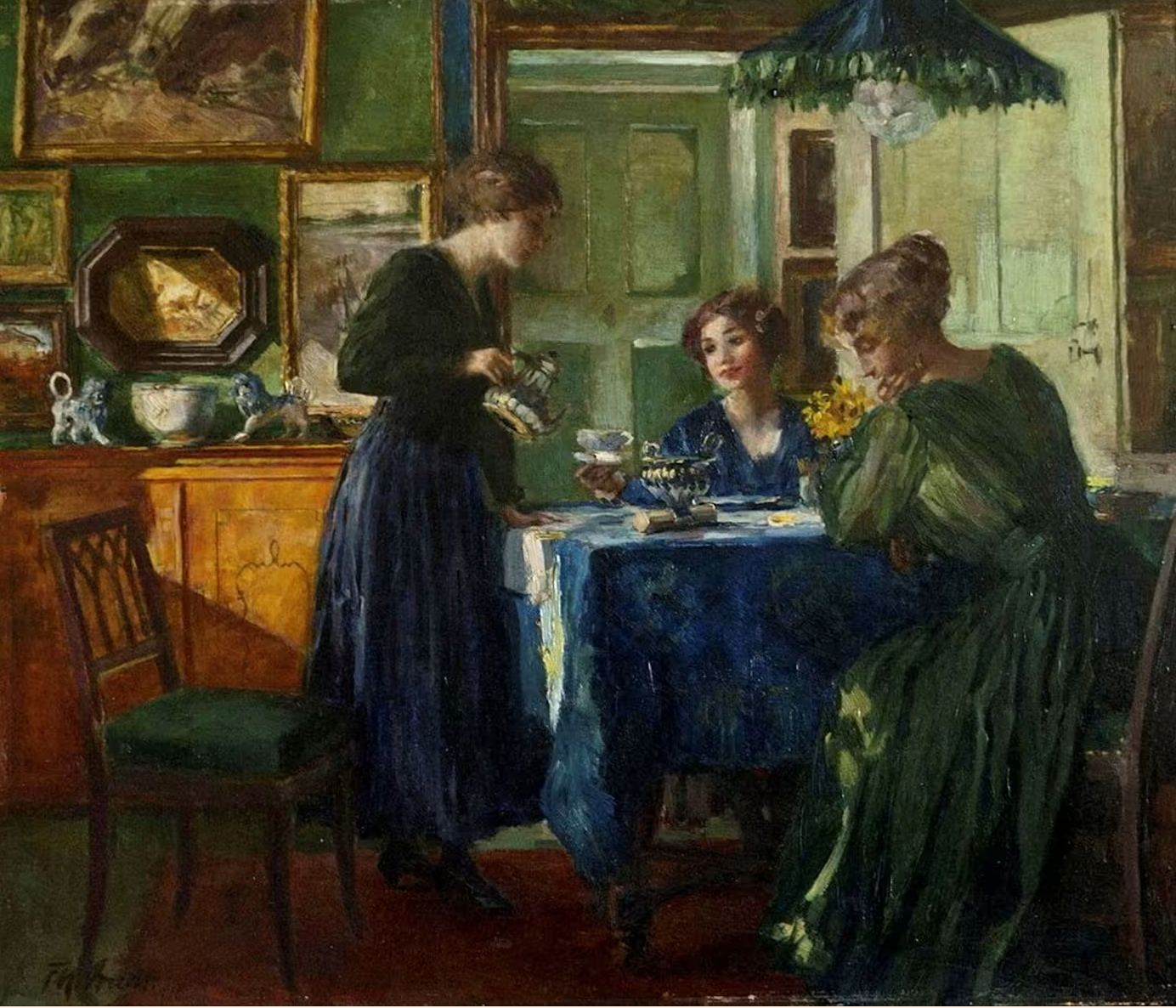
Walk into Ferdinand Max Bredt’s Breakfast During Wartime and you do not enter a painting of heroic sacrifice or noble suffering. You step into a perfectly appointed middle-class German room in 1918 where three women are performing the ancient ritual of breakfast with the grim concentration of people who know the performance is the only thing keeping them upright.
The space itself is handsome, even enviable: green panelled walls crowded with framed landscapes and still lifes, a solid wooden sideboard bearing blue-and-white porcelain dogs that stare blankly into the middle distance, a blue cloth on the table, yellow flowers that look freshly cut. Light floods in from an open door behind them, suggesting garden or veranda, a world outside that still exists. And yet the room feels airless. The war is not depicted: there are no newspapers with casualty lists, no black armbands, but it is present in every averted eye and careful gesture. Bredt, the professional fantasist of odalisques and Turkish courtyards, has done something quietly radical: he has painted the home front as it actually felt: not in propaganda posters, but in the clink of good china.
The composition is deceptively simple. The three figures form a tight, almost claustrophobic triangle around the table. Your eye moves from the standing woman pouring tea, to the seated woman in blue who holds her cup like an offering, to the woman in green whose turned back and hand-to-chin pose carries the entire emotional weight of the picture. There is no grand architecture, no dramatic chiaroscuro. Just the ordinary furniture of a life that is trying, desperately, not to notice it is ending.
The war is not in the room. The war is the room.
— Philibert Octavian de GramontThe Three Women Who Are Not Performing for Us
Let us name them by their roles rather than by names we do not know. On the left, the server: dark hair, dark dress, profile sharp against the green wall. She pours from a silver teapot with the steady hand of someone who has done this a thousand times and will do it a thousand more if the world allows. Her body is angled toward the table but her attention seems elsewhere: inward, or toward the door, or toward whatever news may come through it.
At the centre, the woman in blue: younger perhaps, auburn hair caught with a small flower or ribbon, holding cup and saucer as if they are the most precious objects in the world. Her face is open, almost hopeful, but the eyes are watchful. She looks toward the standing woman, or perhaps past her toward the light. There is no coquetry here, no invitation to the viewer. She is simply present, holding the line.
On the right, the woman in green: turned almost completely away from us, one hand raised to her chin in that universal gesture of worry or contemplation that needs no translation. Her dress is rich, her hair elaborately dressed with a yellow bloom. She is the emotional centre of gravity. Everything in the painting leans toward her silence.
The objects are not props; they are evidence of a class and a moment. The silver teapot speaks of money that has not yet been entirely consumed by war bonds or inflation. The blue-and-white dogs on the sideboard are the sort of cheerful, slightly absurd collectibles that filled German bourgeois homes: faithful, decorative, utterly useless in a crisis. The yellow flowers on the table are the most heartbreaking detail: someone has still bothered to arrange them, to insist that beauty has a place even now. The rolled papers or letters near the teapot may be nothing; or they may be the latest field postcard, or the latest list of the missing. Bredt leaves it ambiguous, and the ambiguity is the point.
No Blood, No Glory: Just Three Ordinary Women
Bredt does not paint victims. He paints women who are still managing the furniture of their lives while the world outside rearranges itself in blood. Their expressions are not theatrical grief; they are the ordinary, exhausted faces of people who have already done the arithmetic and decided to keep pouring the tea anyway. That is what makes the picture sting.
Precision Without Pity: Bredt’s Quiet Report from the Home Front
Bredt built his reputation on lush, detailed Orientalist fantasies: odalisques in silk, courtyards heavy with pattern and suggestion, skin that glowed like something you could almost touch. In those works the brush is often voluptuous, the colour saturated, the gaze frankly erotic. Here, in 1918, the same hand has tightened. The paint is still handled with skill (look at the way the blue cloth catches the light, the way the green dress folds and catches shadow, the subtle modelling of the faces), but the sensuality has been replaced by something more like forensic tenderness.
The palette is deliberately restrained: deep forest green on the walls and the right-hand dress, a cooler blue on the cloth and the central figure’s gown, warm but not glowing flesh tones, accents of yellow in the flowers and the standing woman’s skirt. There is no exotic gold or crimson here. This is northern European light: clear, slightly cool, unforgiving. The brushwork is precise enough to render the silver teapot’s reflection and the individual petals of the bouquet, yet loose enough in the background to let the room breathe. Compositionally it is a masterclass in quiet tension: the open door behind the figures promises escape or news or light, but none of the women look toward it. They are trapped in the ritual, and so are we.
Unlike the theatrical Orientalist scenes where every cushion and curtain is an invitation, this painting offers no entry point for fantasy. The viewer is not invited to desire; we are invited to witness. That shift in address is everything.
Bredt spent a career selling fantasies of the East. In 1918 he finally painted the reality of home; and it is more disturbing than any harem.
— Philibert Octavian de GramontThe Orientalist Who Finally Looked Home, and Saw the End Coming
Ferdinand Max Bredt (1860–1921) spent most of his career doing exactly what the German middle class wanted: painting lush, slightly naughty visions of the East that allowed respectable burghers to enjoy the fantasy of the harem without ever leaving Leipzig or Munich. He travelled to Greece, Turkey and Tunisia, brought back sketches, and turned them into highly finished canvases of odalisques, courtyards and languid beauties. The work sold well. It was exotic, decorative, safely distant.
Then came 1914–1918. By the time he painted this small panel in 1918, Germany had lost a generation, the economy was cracking, revolution was in the air, and the old certainties were dying in the mud of the Western Front. Bredt was sixty-eight. He had perhaps three years left. And instead of another Turkish fantasy, he painted three women in a German room holding a breakfast together by sheer force of habit.
The historical context is everything. This is not a timeless genre scene. It is a document of the home front in the final months of a lost war. The women are almost certainly from the class that could still afford silver teapots and fresh flowers in 1918, the class that had sent its sons and husbands to fight and was now waiting, with varying degrees of stoicism and dread, for whatever came next. The painting does not moralise. It simply records the performance of normalcy at the exact moment when normalcy had become a form of courage (or denial).
The Last Civilised Breakfast
By late 1918 the German home front was under immense strain. Food shortages, grief, and the growing certainty of defeat pressed on every household. Bredt’s picture shows none of that explicitly; and that is its power. The war is present precisely because it is not shown. It lives in the women’s faces and in the viewer’s knowledge of what 1918 actually meant.
The Teapot and The Flowers as The Last Line of Defence
My reading is straightforward and unromantic: this is a painting about the performance of civilisation under conditions that make civilisation almost impossible to sustain. The breakfast ritual (the pouring, the sitting, the flowers, the good china) is not trivial. It is the last available grammar of order. When everything else is collapsing, you still set the table. You still arrange the yellow flowers. You still pour the tea as if the world were not ending in the next room or the next telegram.
The symbolism is quiet but insistent. The silver teapot is continuity: the object that says “we have always done this and we will continue.” The yellow flowers are both hope and memento mori: someone has gone to the trouble of cutting and arranging them, asserting that beauty still matters, even as the season (and the era) turns toward winter. The blue-and-white dogs on the sideboard are absurdly cheerful witnesses: domestic gods that cannot help and cannot leave. The open door behind the women is the threshold between the protected interior and the world that has already broken in emotionally if not yet physically.
To me, the painting means that the real cost of war is often paid in these small, repeated acts of refusal to collapse. It relates directly to the great domestic realists of the nineteenth century, the ones who understood that the most profound dramas happen at kitchen tables, but it carries the specific weight of 1918. It also stands in deliberate contrast to Bredt’s own Orientalist output. Those paintings invited the viewer to escape into fantasy; this one refuses every exit. The women are not available for our desire or our pity. They are simply there, holding the line with whatever they have left.
The flowers are not decoration. They are an argument: beauty is still worth the trouble, even now.
— Philibert Octavian de GramontThe Orientalist Who Finally Painted Something That Couldn’t Be Escaped
What makes Breakfast During Wartime unique in Bredt’s oeuvre, and in the broader landscape of First World War imagery, is its absolute refusal of spectacle. Most wartime art of 1918 is either propagandistic uplift, Expressionist scream, or documentary horror. Bredt gives us none of that. He gives us three women in a room that still looks like a room, performing a ritual that still looks like a ritual, while everything that matters has already changed.
A different perspective sees the painting not as a minor domestic scene but as Bredt’s late, private reckoning with his own artistic habits. The man who had spent decades exoticising the “other” finally turned his precise, academic eye on his own culture at the moment of its greatest crisis, and found the same quiet desperation that he had previously located only in imagined Eastern interiors. The result is more moving, and more honest, than almost anything else he produced. In an age when artists were expected to choose sides loudly, Bredt chose to paint the side that was trying, against all evidence, to remain civilised. That choice feels, even now, like an act of courage.
Beyond the Harem: Into the Real Room
Bredt’s Orientalist works are luxurious, sensual, safely distant. This painting is none of those things. It takes the same technical precision and applies it to a subject that could not be aestheticised away. The result stands closer to the quiet domestic dramas of German Realists or even to the home-front works of artists like Käthe Kollwitz than to anything in Bredt’s own catalogue raisonné. He stepped out of his own myth and painted the truth, once.
The Breakfast That Outlasted the Empire
To stand before Ferdinand Max Bredt’s Breakfast During Wartime is to feel the full, quiet weight of historical irony. The man who made a comfortable living selling fantasies of Eastern sensuality to a German public that would soon lose everything, chose, in the last year of that loss, to paint something small, precise, and unbearably real. Three women. A teapot. Flowers. A room that still pretends the world outside has not changed.
The painting does not offer comfort. It offers recognition. We have all, at one time or another, performed the small rituals that keep us from acknowledging that the larger structure is already gone. Bredt caught that moment, not at its most dramatic, but at its most ordinary and therefore most devastating. The war is not coming. The war is already here, sitting politely at the table, waiting for someone to pour it a cup.