Battle of Lights
An Italian immigrant takes Marinetti's engine-worship to a Brooklyn funfair and paints the resulting collision
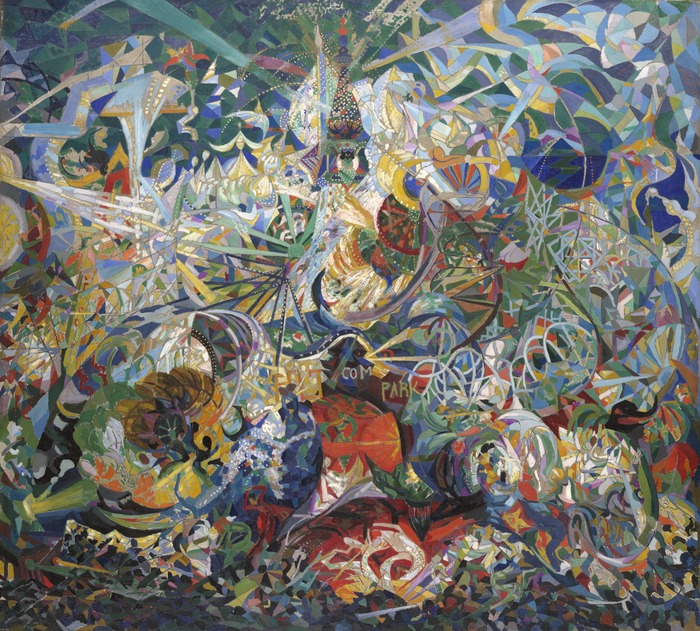
A Brooklyn Funfair Detonates Into Disciplined Colour Chaos
Forget the postcard version of Coney Island: the hot dogs, the salt air, the striped bathing costumes. Joseph Stella has taken a hammer to that picture and painted what is left when the hammer lands. Battle of Lights, Coney Island, Mardi Gras is not a view of a funfair; it is the sensation of standing inside one after dark, when the arc lamps have turned the crowd into silhouettes and the Ferris wheel into a wheel of fire, when the barker's cry and the roller coaster's shriek and the brass band all arrive in your skull at once and refuse to separate into anything as polite as a scene. There is no ground to stand on here, no horizon to steady yourself against. There is only light, breaking apart and reassembling itself, second by violent second.
The composition refuses you a single point of entry. Shards of cobalt, magenta and gold spin outward from a churning centre like glass thrown from a chandelier; near the top a mask-like totem, part carnival face and part machine, presides over the wreckage like a pagan idol installed by the concessions stand. Fragments of signage, the letters C, O, M, appear and vanish among the wreckage, advertising nothing so much as the impossibility of reading anything calmly in a place built to stop you thinking. This is not composition in the old sense, arranging figures in a stable space. It is closer to controlled detonation, and Stella was the man who lit the fuse.
What astonishes, a century on, is how disciplined the chaos actually is. Look past the first assault of colour and you will find real structure underneath: radiating diagonals borrowed from the Ferris wheel's spokes, a rough pyramid of energy rising to that central mask, colour relationships pulled straight from scientific colour theory. Stella was trained as an academic draughtsman before he was anything else, and it shows in the way this apparent riot holds together. The wildness is engineered. That, more than anything, is the joke Stella is playing on every viewer who calls this picture merely hysterical.
This is not composition in the old sense. It is closer to controlled detonation, and Stella was the man who lit the fuse.
— Philibert Octavian de GramontA Crowd Dissolved Into Its Own Machinery
There is, technically, a crowd in this painting, thousands of Sunday trippers who paid their nickel to ride the Steeplechase and scream on cue. You will not find a single one of them intact. Stella has done to the human figure what the midway itself does to human dignity: broken it down, sped it up, and sold it back as spectacle. What survive are fragments, a curve that might be a shoulder, a flash of white that might be a collar, absorbed so completely into the surrounding machinery that you cannot say with confidence where the rider ends and the ride begins. This is the picture's cruellest and most accurate joke: at Coney Island, the crowd was never the audience for the machines. The crowd was the machines' raw material.
Presiding over this wreckage is that extraordinary totemic face near the top of the canvas, feathered, crowned, half Mardi Gras mask and half electrical apparatus, staring out with the blank authority of an idol. It is the picture's one stable presence in a field of collapsing form, and it is deliberately ambiguous: is it a carnival king, a searchlight housing, a nod to the commedia dell'arte tradition that gives Mardi Gras its masks and its licence for misrule? Stella never says, and the refusal to say is the point. Spectacle needs a god, even a fake one built from tin and paint.
The objects are doing the real narrative work. The radiating white shafts are the beams of the electric searchlights that Steeplechase Park used, quite deliberately, to turn night into a second, gaudier day; Coney Island in this period was one of the most intensively electrified places on earth, a proving ground for exactly the kind of artificial illumination that made Broadway famous soon after. The circular and spoked forms are the Ferris wheel and the scenic railway, no longer read as structures but as pure rotational force. And scattered through the lower register, those broken letters, C, O, M, and elsewhere fragments that gesture toward the words PARK, are lifted straight from the resort's own signage, a Cubist trick of collaged text that Stella would have known from Picasso and Braque's Paris, repurposed here to advertise not a product but a state of sensory overload.
Commedia dell'Arte Meets the Power Station
Read the central totem as a carnival mask and the painting becomes a Mardi Gras riot. Read it as a searchlight housing or a dynamo casing and it becomes an ode to electrification. Stella refuses to choose, and that refusal is the whole argument: by 1913, America's new gods of spectacle and America's new gods of industry had become indistinguishable from one another.
Divisionism Detonated: Stella's Recipe for Engineered Chaos
Stella's style here is a hybrid, and understanding its parentage matters more than admiring its fireworks. The bones of the technique come from Divisionism, the late-nineteenth-century Italian offshoot of French Pointillism that Stella would have studied closely on his travels; colour is built from small, distinct touches rather than blended passages, so that the canvas seems to vibrate optically even when nothing on it is actually moving. Onto that scientific scaffolding he grafts the full ideology of Italian Futurism, encountered first-hand in Paris and Rome around 1909 to 1912: the belief that a painting should not depict a static moment but the accumulated sensation of movement through time, what Boccioni and his circle called simultaneity.
The result is a canvas built almost entirely from diagonal and radiating force-lines, the visual grammar Futurism borrowed from photographs of speeding motorcars and spinning machinery. Nothing in this picture sits still, because nothing was allowed to. Even the passages that read, at a glance, as decorative ornament, the beading, the lace-like white filigree threading through the darker shapes, are doing structural work, describing the scatter and afterimage of electric light the way a long photographic exposure would.
The palette is where Stella parts ways most decisively with his Italian teachers. Boccioni and Balla worked in a relatively restrained, almost metallic range of greys, browns and blues. Stella floods his canvas with carnival colour: hot magenta and crimson, incandescent gold, a night-sky cobalt so deep it reads as black until you look twice, and threads of that teal-green so characteristic of period gas and electric signage. This is not the cool intellectual Futurism of the Milan manifestos. It is Futurism dragged through a fairground and dyed in its lights, and the difference is the whole achievement.
This is not the cool intellectual Futurism of the Milan manifestos. It is Futurism dragged through a fairground and dyed in its lights.
— Philibert Octavian de GramontThe Immigrant Who Painted America's Nerve Endings
Joseph Stella was born Giuseppe Michele Stella in 1877 in Muro Lucano, a hill town in the mountains of Basilicata, in a family that expected its sons to become professionals. He crossed to New York in 1896, ostensibly to study medicine like an elder brother already settled there, and lasted barely a season before abandoning the scalpel for the pencil. He trained under William Merritt Chase, one of America's most fashionable academic realists, and for the best part of a decade Stella worked as precisely the kind of artist his instructors wanted: a sharp-eyed illustrator and draughtsman, sent by magazines to document immigrant life at Ellis Island and the brutal industrial machinery of Pittsburgh's steel mills. Those early drawings are sober, humane, almost documentary. Nothing in them predicts what came next.
What came next was Europe. Between roughly 1909 and 1912, Stella travelled through Paris and Italy, and there he collided, hard, with the Futurist movement erupting out of Milan under Filippo Tommaso Marinetti, alongside the wider Parisian avant-garde of Cubism and Delaunay's colour-based Orphism. Marinetti's manifestos demanded an art of speed, machinery and violent modern sensation, contempt for museums, worship of the motorcar and the aeroplane. Stella absorbed the visual vocabulary wholesale and brought it home to New York in 1913, and then did something the Italian Futurists themselves never managed: he found an authentically American subject worthy of the style. Not a battlefield, not a racing car, but a funfair on a Brooklyn peninsula, electrified within an inch of its life and packed with the kind of raucous, working-class, multi-ethnic crowd that the old-world avant-garde rarely painted at all.
The picture was largely finished by late autumn of 1913 and shown soon after in a private New York gallery; it is sometimes loosely bundled together with the epoch-making Armory Show of that same year, the exhibition that introduced American audiences to Cézanne, Matisse and Duchamp's scandalous nude, though the association is more a matter of shared moment than of shared guest list. Either way, the reception was exactly what you would predict: conservative critics called it hysterical and unreadable, while younger painters recognised immediately that an American had out-Futurised the Futurists on their own terms.
The Second Sun of Coney Island
By 1913, Coney Island's amusement parks were burning tens of thousands of incandescent bulbs a night, an almost obscene display of America's new electrical wealth arriving barely three decades after Edison's first practical lamp. Stella's canvas is not exaggerating that light. If anything, it is only just keeping pace with it.
The Promise of Modernity. A Riot Wearing the Costume of a Carnival
My reading of this painting is that it is far less innocent than a century of "joyous Americana" wall labels would have you believe. Mardi Gras, in the European Catholic calendar Stella grew up inside, is not simple fun. It is licensed misrule, one last sanctioned explosion of appetite before the discipline of Lent, and it always carries a current of danger beneath the fancy dress. Stella imports that structure wholesale and grafts it onto a very American institution, the commercial amusement park, and the result is a picture that is celebrating something while quietly recording its violence.
Look again at that central mask. In the commedia dell'arte tradition that gave Mardi Gras its stock characters, masks conceal identity so that ordinary rules can be suspended. Here the mask has fused with machinery, and I take that fusion to be the picture's real subject: the electrified marketplace had become the new licensing authority for misrule, replacing the church calendar with the amusement park's opening hours. The crowd fragments not because Stella lacked the skill to paint individuals, he had already proved that skill at Ellis Island, but because the spectacle itself was designed to dissolve the individual into a paying, screaming, indistinguishable mass. The fragmented letters, C-O-M, gesturing toward both "commedia" and the resort's own advertising copy, reinforce the point: even language gets sold back to you in pieces at Coney Island.
To me, this canvas means that modernity's great fairground promise, more light, more speed, more sensation, always arrives with an unpaid bill attached. It sits in direct lineage with Bruegel's crowded moral panoramas of peasant festivity, minus the finger-wagging, and looks forward, whether its own Italian teachers would admit it or not, to every twentieth-century artist who painted the city as an overstimulated nervous system rather than a stable backdrop. Stella is less interested in condemning the carnival than in being honest about what it costs to attend it.
The electrified marketplace had become the new licensing authority for misrule, replacing the church calendar with the amusement park's opening hours.
— Philibert Octavian de GramontThe Immigrant's Eye, Not the Futurist's Manifesto
What makes Battle of Lights unique, and what the standard story of "American Futurism" tends to flatten, is that Stella did not arrive at this subject as a native son celebrating his own culture's toys. He arrived as an immigrant, still barely two decades off the boat himself, painting an entertainment built substantially for and by other immigrants, the largely Italian, Jewish and Irish working-class crowds who flooded Coney Island on a Sunday because Manhattan offered them nowhere else to be loud. Every Italian Futurist manifesto Stella had read in Europe was written by comfortable Milanese intellectuals fetishising speed from a position of considerable safety. Stella was painting speed and spectacle from inside the crowd being fed to the machine.
Read that way, a different, more unsettled picture emerges. This is not simply a hymn to modern excitement; it is close to a portrait of sensory assault, of the disorientation that comes from trying to hold your footing inside a system, cultural, commercial, electrical, that was never designed with your comfort in mind. The mask-god presiding over the wreckage stops looking benevolent and starts looking closer to an idol demanding tribute. Seen through the immigrant experience Stella himself had lived, of arrival, overwhelm, and the constant pressure to dissolve into a new and disorienting American mass, the painting's violence is not incidental to its joy. It is the same sensation, seen from two directions at once, and Stella, unlike his Italian teachers, had actually lived on both sides of it.
So I end where Stella began: with an immigrant draughtsman deciding that a Brooklyn funfair deserved the full machinery of modern style. He was not wrong. The amusement parks have been demolished and rebuilt and demolished again; the particular bulbs of 1913 are ash. The painting remains because it recorded not a brand of lightbulb but a new condition of seeing, one we still live inside whenever a city offers more simultaneous claims on our attention than any single conscience can answer. That is the real battle of lights, and Stella painted it before most Americans had language for the problem.
Readers who know Stella mainly through his later Brooklyn Bridge pictures sometimes treat Battle of Lights as a youthful experiment on the way to those more stable icons of American modernism. I reverse the hierarchy. The Bridge paintings are superb, but they recover a measure of architectural calm that this earlier canvas deliberately refuses. Coney Island is Stella at maximum risk: maximum colour, maximum fragmentation, maximum trust that the American popular subject could carry high modernist form without apology. If you only have time for one Stella in which the immigrant eye and the European manifesto collide at full force, start here rather than with the more frequently reproduced bridges.
And if you leave the gallery remembering only fireworks, go back. Under the fireworks is a theory of modern attention. Stella is not decorating a fairground. He is testing how much simultaneous claim on the eye a single rectangle of canvas can bear before representation itself becomes another ride. That test is why the painting still feels contemporary in an age of screens that sell the same overstimulation by other means. The bulbs have changed. The battle of lights has not ended.
One more point about colour, because colour is doing structural work here that line alone cannot. Stella does not use electric yellows and magentas as local description of bulbs and banners only. He uses them as the primary architecture of space. Where a Renaissance painter would have built recession with linear perspective, Stella builds a kind of optical recession with temperature and saturation: hot centres, cooler fragments, white-hot flares that push forward and muddy greys that fall back. The result is a shallow, vibrating field rather than a deep stage. You do not walk into this picture. It walks into you, which is exactly how a night of overstimulation feels when you are no longer sure whether you chose the ride or the ride chose you.
I also want to defend Stella against the charge, still occasionally muttered in survey texts, that American Futurism was a brief, derivative episode without the political seriousness of its Italian model. Derivative is the wrong word for a painter who changed the subject of the language he borrowed. Political seriousness is not limited to war and industry. The politics of leisure, of who gets to spend Sunday in light and noise, of how commerce organises desire, are politics too. Stella painted those politics in 1913 and 1914 with a formal intensity that still makes quieter American scenes from the same years look underpowered. If the movement was brief in America, that is a fact about American reception, not about the quality of this particular wager on canvas.
When the lights finally seem to settle, after long looking, what remains is not a resolved composition but a remembered tempo. Stella's Coney Island keeps reopening itself. That is the test I apply to modern paintings of speed: not whether they illustrate motion, but whether they continue to move after you have named every influence and every amusement-park reference. This one does. The Ferris wheel's steel geometry, the mask's authority, the crowd's broken bodies, the half-words of advertising, all of it keeps rearranging under the eye. A picture that can still do that after more than a century has earned its place not as a historical specimen of Futurism-in-America, but as a permanent instrument for thinking about cities that sell sensation faster than citizens can metabolise it.
The Armory Show of 1913, which opened in New York just as Stella was beginning this canvas, had already forced American audiences to confront European modernism in bulk: Cubism, Fauvism, the shock of Duchamp's Nude Descending a Staircase. Stella's contribution to that confrontation was not to import a European subject but to prove that the new formal language could seize an American subject that no Milanese Futurist had ever bothered to paint. Coney Island was not a racetrack, not a battlefield, not a factory floor. It was a commercial pleasure machine built for people who worked six days and spent the seventh trying to feel something louder than work. By applying force-lines, fractured lettering, and Orphist colour discs to that subject, Stella performed a quiet act of cultural translation that the Italian manifestos, for all their noise, never attempted.
Look carefully at how the picture handles lettering. The broken C-O-M sequence and the half-swallowed signs for Steeplechase and Feltman's are not decorative afterthoughts. They are evidence that advertising itself had become a structural element of the modern optical field. Stella had trained his eye on immigrant faces at Ellis Island and on industrial labour in Pittsburgh; he knew how to record the world as documentation. Here he records the world as bombardment. Words arrive the way light arrives: in pieces, too fast to assemble into a full sentence before the next burst overwrites them. That is not merely a Futurist trick borrowed from collaged newspaper. It is a report on what it felt like to stand inside a night economy designed to keep you from ever finishing a thought.
I am also unconvinced by the long American habit of hanging this canvas as pure celebration, a cheerful postcard of national exuberance. The title itself is double-edged. A battle of lights is still a battle. Mardi Gras is still the night before fasting. Stella's own written recollection of Coney Island spoke of violent, dangerous pleasures and of machines generating a surging crowd; those are not the adjectives of a man painting a picnic. The central mask-form that seems to preside over the composition can be read as carnival gaiety, but it can equally be read as an idol that has swallowed the individuals who feed it. Great modern pictures often carry both readings at once. This one does, and criticism that chooses only the cheerful half is doing half a job.
Technically, the canvas is a lesson in how an American painter could absorb European systems without becoming a provincial echo. From Balla and Boccioni he takes the conviction that motion is truer than the static pose. From Severini's nightclub pictures he takes the permission to treat entertainment as a serious modern subject. From Delaunay he takes the radiating discs of pure colour that turn electric lamps into structural geometry rather than local highlights. What he does not take is the Italian Futurists' political swagger, their war-as-hygiene rhetoric, their contempt for the crowd as raw material for the state. Stella's crowd is not raw material for anyone's programme. It is the immigrant and working-class public he had already spent years looking at, now rendered as pure optical pressure. That difference of sympathy is the American difference, and it is why this painting still feels local even when its grammar is international.
Yale's holding of the picture also matters to how we see it now. Institutional walls can flatten even the wildest modernism into a lesson about "American innovation," and there is truth in that lesson: Stella did invent an American Futurism, or at least proved that Futurism could be rewritten in American vernacular. But the museum frame should not erase the class and immigrant texture of the original subject. Steeplechase Park is gone. The particular night economy of 1913 Coney Island is gone. What remains is Stella's decision that those crowds, those bulbs, those half-legible signs deserved the same formal seriousness Europe reserved for locomotives and riots. Standing before the canvas today, you are not merely looking at a chapter in the history of style. You are looking at a young immigrant artist's wager that American pleasure was already modern enough to fracture a painting, and that the fracture could still be beautiful.
If you want a final formal test, try this: cover the lower third of the picture with your hand and watch how the upper field continues to spin without narrative support. Then uncover it and notice how the crowd fragments do not restore narrative so much as multiply centres of attention until attention itself becomes the subject. Stella is not telling you a story about one night at Coney Island. He is modelling the nervous system that night produces. That is a higher ambition than documentation, and a more durable one. Documentation expires when the park closes. A model of overstimulation remains useful every time a city invents a new way to sell light faster than the eye can keep up.
Beyond Milan: Stella's Real Company
Stella absorbed the Italian Futurists' force-lines and their contempt for the static image, then dragged the whole apparatus somewhere none of them ever painted: an American funfair, dyed in carnival colour rather than industrial grey. The result sits closer to the Parisian Orphists' love of pure colour than to Futurism's cooler machine-worship, a hybrid, American picture.
The Lights Go Up, and Nobody Ever Quite Recovers
To stand before Battle of Lights, Coney Island, Mardi Gras is to feel a hundred-and-twelve-year-old canvas still running at full voltage. Stella took a European manifesto built for racing cars and battlefields and proved it could just as easily describe a Brooklyn funfair on a Saturday night, which is either the movement's finest vindication or its gentlest mockery, and I have never quite decided which. Perhaps that refusal to decide is the whole point of great criticism, and of great carnivals.
What endures is not the argument about Futurist orthodoxy but the sheer nerve of the thing: an immigrant draughtsman, barely a decade off the boat, looking at America's gaudiest working-class pleasure palace and deciding it deserved the same seriousness Europe reserved for revolutions. He was right. The lights he painted have long since been switched off, Steeplechase Park itself demolished decades ago, but the sensation of standing inside that particular riot of colour has not dimmed by a single watt.